Thursday, August 30, 2007

Maps, and a Google tweak

Via iSpecies:
Today I stumbled across the Species Distribution Widget from GBIF (written by Tim Robertson and Dave Martin). For Mac OS X 10.4 users, this provides a cool way to quickly get a distribution map for a taxon. Given that Apple dashboard widgets are essentially Javascript and HTML, it occurred to me to reverse engineer the widget to see what it did. To open the widget you just "Ctrl-click" on the widget icon, select Show Package Contents, and the contents open in a Finder window.


The guts of the widget is in the scripts folder. This contains a Javascript file. The widget calls the URL http://data.gbif.org/species/taxonName/ajax/returnType/concept /view/ajaxMapUrls/provider/1/?query=, to which is appended the taxon name you are searching for. Back comes the result in XML. For example, searching for Apus apus returns:


Apus apus
Common swift
13836131
species/13836131/overviewMap.png


(Shouldn't "taxons" be "taxa"?) The URL of the corresponding map is given in the tag. Append this to "http://data.gbif.org/, and you have the URL for the image of the map. For example, here's the map for Apus apus.


I've added code to do this to iSpecies, so it now features maps from from GBIF. I've also finally tweaked the Google code to stop mangling UTF-8 characters.

Mobility promotes and jeopardizes biodiversity in rock–paper–scissors games


Authors: Tobias Reichenbach, Mauro Mobilia & Erwin Frey

Abstract

Biodiversity is essential to the viability of ecological systems. Species diversity in ecosystems is promoted by cyclic, non-hierarchical interactions among competing populations. Central features of such non-transitive relations are represented by the 'rock–paper–scissors' game, in which rock crushes scissors, scissors cut paper, and paper wraps rock. In combination with spatial dispersal of static populations, this type of competition results in the stable coexistence of all species and the long-term maintenance of biodiversity. However, population mobility is a central feature of real ecosystems: animals migrate, bacteria run and tumble. Here, we observe a critical influence of mobility on species diversity. When mobility exceeds a certain value, biodiversity is jeopardized and lost. In contrast, below this critical threshold all subpopulations coexist and an entanglement of travelling spiral waves forms in the course of time. We establish that this phenomenon is robust; it does not depend on the details of cyclic competition or spatial environment. These findings have important implications for maintenance and temporal development of ecological systems and are relevant for the formation and propagation of patterns in microbial populations or excitable media.

Wednesday, August 29, 2007

Mobile phones for owl tracking

I love it when people use new technology to accomplish classic research:

Researchers at MIT are using mobile phones to help count owls in forests. Professor Eben Goodale and his colleagues placed tricked-out cell phones in various parts of a forest. When Goodale dials the owls' numbers, the mobile phones play owl calls from their speakers and record the responses. From The Telegraph:
OwllllOne use has been to track great horned owls in Louisiana and their effects on local swallow tailed kite populations. In the new study, they show that Barred Owls and the Eastern screech owl are also happy to take a call on the mobile.
Traditionally, bird surveys rely on people standing in the woods, playing a CD of bird calls, and taking note of the birds they hear responding. It can be labour intensive and inexact.

The researchers now plan to compare a survey conducted with 65 phones with one that relies on CD recordings used by 250 volunteers from the Audubon Society in Maine to see if the mobiles do as well. The advantage is that the new method allows ornithologists to dial up birds anywhere on the planet, and to cover a large area at the same time.
Link to The Telegraph, Link to Owl Project. (Via BoingBoing)

Tuesday, August 28, 2007

As Brazil Defends Its Bounty, Rules Ensnare Scientists

Via: NYT

Marc van Roosmalen is a world-renowned primatologist whose research in the Amazon has led to the discovery of five species of monkeys and a new primate genus. But precisely because of that work, Dr. van Roosmalen was recently sentenced to nearly 16 years in prison and jailed in Manaus, Brazil. Earlier in August, his lawyers managed to get him freed while they appeal his conviction on charges stemming from an investigation into alleged biopiracy. But scientists here and abroad are outraged, and they describe the case as only the most glaring example of laws and government policies they say are xenophobic and increasingly stifling scientific inquiry.


“Research needs to be stimulated, not criminalized,” said Enio Candotti, a physicist who has been the president of the Brazilian Society for the Progress of Science, the country’s leading scientific body, for the last four years. “Instead, we have a situation in which overzealous bureaucrats consider everyone guilty unless they can prove their innocence.”

At a biologists’ conference in Mexico last month, 287 scientists from 30 countries signed a petition saying that the jailing of Dr. van Roosmalen was “indicative of a trend of governmental repression of scientists in Brazil.”

The treatment of him, they warned, is unduly harsh and is “already discouraging biological research in Brazil, both by Brazilian scientists and by potential international donors.”

Brazil’s government officials say they have no vendetta against the scientists and are merely trying to protect the nation’s natural and genetic patrimony; they also declined to talk about the van Roosmalen case.

Read rest of article here

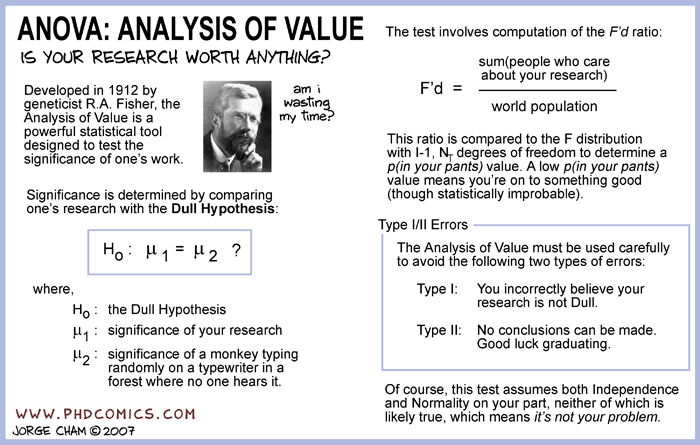
Via PhD Comics

Sunday, August 26, 2007

Ants on a Plane

I know, I should be ashamed for that one.

If you ever felt like one of the “ants” in a Dave Matthews song while marching through Phoenix Sky Harbor International Airport, there might be something to it.

Southwest Airlines researchers trying to mimic the efficiency of marching ants tested a computer simulation at the airport in 2004, trying to get airplanes through the gates faster.

[read the rest of the article in the Arizona Republic]

Meanwhile, in Australia, researchers studying swarm behavior are finding:

A panicking crowd can be evacuated faster by placing certain types of obstacles in its path, according to Australian researchers who say we can learn from the masters of crowd control: ants.

Associate Professor Martin Burd from Monash University is using Argentine ants (Linepithema humile) to model the behaviour of panicking crowds.

[read the rest of the article]

Leave No Rock Unturned: A Great Idea!

Via Ontogeny via Coturnix...via Dave, Fred, and Bev (Dave also explains the details):

On September 2nd this year go out somewhere: into your backyard, or the woods, or the bottom of the sea, and turn a rock or two or three. Take pictures of what you find underneath. Perhaps you'll find earthworms, or pillbugs, or beetles. Or a starfish. Maybe even a snake. Perhaps even a snake guarding the entrance to Dick Cheney's Undisclosed Location. If you turn a rock in Iraq and find WMDs please let us all know as that would be the biggest scoop in the history of the blogosphere (good luck with that one, though).

The idea was hatched by Dave Bonta, Fred Garber and Bev Wigney. Dave explains in detail.

Post your pictures on your blog and send Bev the URL, or post them on this Flickr tag, or send them to Bev at bev (at) magickcanoe (dot) com (with "Rock Flipping" in the subject line). Then sit back and watch the collection grow. See what others find under the rocks on that day. Post a link on your blog as well.