Monday, December 08, 2008

Ant #4 (Tim and Kari): ceramic planter

So, if anyone out there recalls my fabulous idea of creating an ant a day, they will also recall that I have been an abject failure at doing so. I shall now move into a mode involving showing ants I created in the past, that are just sitting around the apartment, rather than ants that I created for this project. Next I shall no doubt move into a mode involving showing ants other people have made that are just sitting around my apartment. Sigh. This is a ceramic planter I made for a ceramics class several years ago. It is actually a collaborative piece between my husband and I, who created a rolling ant stamp that I used in the design.

Wednesday, October 08, 2008

Dance Your PhD! (Possibly the coolest thing ever)


Dear God: Please please please let me have the motivation (and balls) to enter this contest. Amen.


The 2009 AAAS Science Dance Contest

HOW TO ENTER:

The contest is open to anyone who has (or is pursuing) a Ph.D. in any scientific field, such as physics, chemistry, biology, psychology, anthropology, or in science-related fields such as mathematics, engineering, linguistics, bioethics, the history of science, etc. regardless of whether you've remained in academia.

1. Make a video of your own Ph.D. dance.

2. Post the video on YouTube. In the video's information box, include your Ph.D. title and any relevant information (scientific or artistic) that you'd like to share.

3. Not later than 23:00 EST 16 November 2008, email your name; current affiliation and status; the title of your Ph.D., university where it is earned, and completion date; and the Internet link to your Ph.D. dance video to: gonzo@aaas.org

Once this information is posted on the Contestants video page, you are officially entered in the contest.

* * Submission deadline: 16 November 2008 * *

HOW TO WIN:

On 17 November 2008, an independent panel of judges will select a total of 4 winners from the following categories:

Graduate Student: Best among those currently enrolled in a Ph.D. program

Post-Doc: Best among those who have a Ph.D. but not tenure at a university

Professor: Best among those with Ph.D. and tenure at a university

Popular Choice: The video with the highest YouTube viewcount by the deadline

If a dance video wins in both the Popular Choice and another category, the video with the next highest viewcount wins the Popular Choice award. The dance can be solo or a group effort, but the author of the Ph.D. must appear in a central role. This is a dance contest, not a video contest, so the judges will focus on the quality of the dance rather than any fancy editing you do with iMovie. The winning dances will be those that most creatively convey the scientific essence of their respective Ph.D. theses.

THE PRIZE:

On the day you are chosen as a winner, you must submit a single peer-reviewed research article on which you are a co-author. (Graduate students who have not yet co-authored an article must choose one co-authored by their Ph.D. advisor.)

Each of you will be paired with a professional choreographer. (A team of 4 choreographers in Chicago are ready and waiting.) Over the next couple of weeks (via email and telephone) you must help your choreographer understand your article, its aims, the hypotheses it tests, and its big-picture context. With that knowledge, the choreographers will collaborate to create a 4-part dance based on the science behind the 4 winning research articles.

You will be honored guests at the 2009 AAAS Annual Meeting in Chicago in February. Accommodation for 2 nights will be provided, and travel grants are available to help cover your expenses.

During the AAAS meeting, on 13 February 2009, you will have front row seats to the world debut of "THIS IS SCIENCE"--the professional dance interpretation of your scientific research.

Monday, September 29, 2008

Ants in the New Yorker


Who says you have to go to the far off jungles to study ant diversity? Check out this New Yorker article on the work of former graduate student Marko Pecarevic entitled Ant Diversity and Abundance Increase with Increasing Plant Complexity and Amount of Garbage Bins in New York City Street Medians.

Via bridgeandtunnelclub

Sunday, September 28, 2008

How to Identify Queens


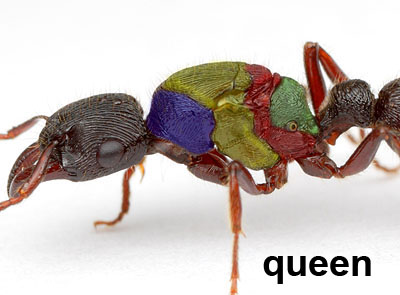
Alex over at Myrmecos has a fabulous post on how to identify queens. It is the clearest, most useful explanation I have ever seen, with some wonderful images to illustrate. I really wish I had had this when I was first starting out. Go check it out and thank Alex for all the hard work he clearly put into this. Thanks Alex!

Friday, September 19, 2008

Check List: journal of species lists and distributions


Just had this journal pointed out to me today. From their website:
CHECK LIST is a quarterly journal devoted to publishing species occurrence lists, geographic distribution maps, and notes on the geographic distribution of any taxon. These reports have traditionally been neglected and considered "too basic" or "not scientifically relevant" for publication in other venues. CHECK LIST seeks to remedy this. Efforts to preserve the remaining ranges of species are fundamental for the conservation of biodiversity and the first step to accomplish this is to keep records of the distribution of the species. CHECK LIST was created to fill this gap by publishing papers on these important inventories.
It looks like it is a Brazilian-based effort by CRIA (Centro de Referência em Informação Ambiental), a "non-profit and non-governmental Brazilian organization that aims to contribute to the conservation of global biodiversity by dissemination of high quality scientific information." Since 2005 they have published 11 issues (in English) online. Papers are peer-reviewed, turn-around is quick, and there are no publication costs. Sounds good to me. Check them out here.

Thursday, September 18, 2008

Scratchpads: biodiversity online

Scratchpads: Biodiversity Online is an online biodiversity site (duh) that looks very promising. From their website:

Scratchpads are an easy to use, social networking application that enable communities of researchers to manage, share and publish taxonomic data online. Sites are hosted at the Natural History Museum London, and offered free to any scientist that completes an online registration form. Key features of the Scratchpads include tools to manage:

Taxonomy Classifications Phylogeny Phylogenies
Literature Bibliographies Documents Documents
Images Image galleries Custom Data Custom data
Specimens Specimen records Simple Maps Maps

Users control who has access to content, which is published on the site under Creative Commons (by-nc-sa) license.


Data added to a Scratchpad are automatically classified and grouped around a taxonomy that is supplied by the users. This is optionally supplemented with information from high quality web accessible databases, to automatic construct content rich web pages about any documented taxon. Currently these sources include Genbank, GBIF, Biodiversity Heritage Library, Yahoo! Images, flickr and Google Scholar.


Want to learn more? I do!


  • Roberts, D., Rycroft, S.D., González, M., and Smith, V.S. (2007) Scratchpads: what are they? European Distributed Institute of Taxonomy News (newsletter article).
    PDF


  • Smith, VS.* (2008) Cybertaxonomy: applying computers & the Web to the study of biodiversity. Invited. Part of the Voyages of Discovery lecture series. Natural History Museum, London, U.K. April 22, 2008.
    PPTSlideshare


  • Smith, VS.*, Rycroft, S.D. & Roberts, D. (2008) Scratchpads: Getting biodiversity online, redefining publication. Invited. NHM trustees presentation. Natural History Museum, London, U.K. March 4, 2008.
    PPTSlideshare


  • Smith, VS.*, Rycroft, S.D., & Roberts, D. (2008) Scratchpads: Getting biodiversity online, redefining publication. EDIT general meeting, Carvoeiro, Portugal. Jan. 24, 2008.
    PPT Slideshare

Tuesday, August 19, 2008

ZooKeys: new online journal edited by Terry Erwin


From their website:
"ZooKeys is a peer-reviewed, open-access, rapidly produced journal launched to support free exchange of ideas and information in systematic zoology.

All papers published in ZooKeys can be freely copied, downloaded, printed and distributed at no charge for the reader. Authors may retain all other rights on their works. Authors are thus encouraged to post the pdf files of published papers on their homepages or elsewhere to expedite distribution.

Papers are published both online and in the traditional printed format, in full compliance with the current requirements of ICZN."


The abstract from the editorial opening paper:
"Publishing taxonomic and systematics studies in the digital era faces major challenges and requires new approaches, many of which are currently stimulating spirited discussions amongst taxonomists and systematists. New amendments to the International Code of Zoological Nomenclature are expected to regulate electronic publishing of new taxa and create a standard form for their registration (ZooBank). Responding to a perceived need, this editorial announces establishment of ZooKeys – a new online and print journal in zoological taxonomy and systematics, which aims to quickly respond and adapt to the newest developments in taxonomic publishing. Open Access is accepted as mandatory for ZooKeys. Th e rationale for and concept of ZooKeys is discussed in detail."
Check it out here.