Saturday, November 18, 2006

Ant Types in German Collections


This week, I received an email from Christiana Klingenberg about the launch of the new FoCol website, which aims to have all taxonomic information on German ant types (about 3000 entries of some 1500 type taxa and more then 17.000 photos) available online by the end of 2007 (the page says 2006 at one point but I think it is a typo as 2007 is stated everywhere else). Right now there are lists of specimens and information about the project in general. I think if you actually want to see images right now, you need to contact Christiana. Anyway, looks like it will be a great resource. Check it out here.

Update: Whoops! I misspelled the project name. It is FoCol, not FoCal.

Tuesday, November 14, 2006

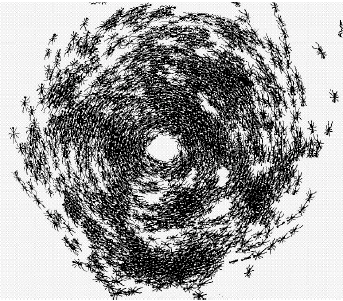
Ant Death Spiral

This is one of my favorite things about ants -- the ant death spiral. Actually, it's a circular mill, first described in army ants by Schneirla (1944). A circle of army ants, each one following the ant in front, becomes locked into a circular mill. They will continue to circle each other until they all die. How crazy is that? Sometimes they escape, though. Beebe (1921) described a circular mill he witnessed in Guyana. It measured 1200 feet in circumference and had a 2.5 hour circuit time per ant. The mill persisted for two days, "with ever increasing numbers of dead bodies littering the route as exhaustion took its toll, but eventually a few workers straggled from the trail thus breaking the cycle, and the raid marched off into the forest."

Folks interested in things like self-organization, emergant properties, complex systems, etc. etc. like to point to this as a cautionary tale. I even found a reference to a group programming robots to interact like ants that accidentally produced this behavior in their robots. Apparently you can also reproduce this behavior in the lab by placing a glass jar into the surface. The ants will eventually circle the jar and continue to do so even after the jar has been removed. I assume just army ants. Wow, I wish we had an army ant colony in the lab.

Anyway, in tribute to this fabulously bizarre phenomenon, I made some Ant Death Spiral
T-shirts. Check them out!

Other references:


Monday, November 13, 2006

Identifying male ants III


Another resource is the Japanese ant image website, which has a male ant key to the Japanese subfamilies. I will give it a try and see if it is helpful. Also, see the comment by Alex (I assume Wild) under Identifying male ants II. He has some hints on Linepithema males. He also suggests that the best course of action is simply to look at a lot of males in the genera and species that I have already identified and just try to get the general feeling for what the males look like. That seems like a great idea but I have so many friggin' genera and species that I find the prospect a little overwhelming.

Thursday, November 09, 2006

Identifying male ants II

So I got an email from Christiana Klingenberg yesterday pointing me to another key to male ants:

Yoshimura, M. & Onoyama, K. 2002. Male-based keys to the subfamilies and genera of japanese ants (Hymenoptera: Formicidae). Entomological Science, 5 (4): 421-443.

I don't have access to this article but have ordered it from my school library and will let you all know if it is useful or not.

She also mentions that:
"A few years ago Bodo Hasso Dietz and I had the same problem with males of Basicerotini and Attini. Checking out male and female wings we saw that both are very similar. So maybe comparing the wings of males with "identified winged females" could help. But this works only up the genus level, not for species."

Thanks for the tips! Anyone else?

Wednesday, November 08, 2006

Identifying male ants

So... I have all these reproductives. Hundreds. A lot of them I have been able to pull out and identify to genus because they look so much like the workers. Crematogaster queens, for instance, all have that very obvious gaster attachment. Easy. A lot of Wasmannia queens have that same scrobe/frontal lobe configuration that just says Wasmannia to me. Attine queens seem to all have that Attine look to them. I still have a lot left, though. Mostly from the canopy. And then there are the males. Boy, I really hate males. As far as I can tell, they look nothing like the workers at all. I can't even put them reliably into subfamilies because things like petiole number or antennal segment number can be different. Yesterday I posted to The Ant Farm's and Myrmecology's Message Board asking if anyone had any suggestions on how to ID male ants. Surprisingly, someone actually did. I was pointed to a 1943 paper by Marion R. Smith. There is a link to it on antbase. org. It is only for male ants of the United States, and it was written quite awhile ago, but it's the first thing I've seen that even attempted to do this, so I am overjoyed. I will let everyone know how it goes. In the meantime, if anyone else has any hints or suggestions, I would be happy to post them here.

Gordon Snelling writes that army ant males are very easy to identify as they have "very elongate and hairy gasters. All other male ants have gasters which are distinctly smaller than thorax and head, in the case of AAs, gaster is usually much larger or at least equal. Additionally they have very large mandibles compared to other male ants and are very distinctive as a result." The picture below links to his army ant website.


Update: see post Identifying male ants II

Army Ants


So... I received a very nice offer from Gordon Snelling to look at my army ants. At first I thought I didn't need this as I had already identified all of my army ants, but upon further consideration decided to take him up on his offer. There were a few I was iffy on. So off they go. I'll keep everyone updated.

Friday, November 03, 2006

Insect Photos

Found this link today on BoingBoing to a fantastic gallery of macro insect photos. No ants, but still worth checking out.