Wednesday, September 27, 2006

Timorous Beasties


Look at these fabulous designs from the even more fabulously named store Timorous Beasties!

(via BoingBoing via CribCandy).

Wednesday, September 20, 2006

The two most powerful forces

E. O. Wilson's new book, The Creation, is an attempt to get two groups of disparate folks -- scientists and evangelical Christians -- together on the one issue that Wilson believes they can agree on: saving life on earth.

As Wilson says, science and religion are "the two most powerful forces in the world today." What wonders could be accomplished if they were on the same side?

Here is a link to an article in the Washington Post.
And another link to an interview with Wilson and Dr. Gerald Durley, Pastor of the Providence Missionary Baptist Church of Atlanta, Georgia, on NPR.


Monday, September 18, 2006

Wasmannia

Drawing by Christine Parent


I have just finished updating my Wasmannia page. Previously I had been using the Costa Rica key, which is somewhat helpful, but I knew I definitely had ants that weren't there. I had heard a new revision and key was coming out soon, but this has yet to actually appear. Luckily, I was able to talk to Jack Longino at the IUSSI conference and he kindly forwarded a copy of the new key to me. Happily, it was fairly straightforward and easy to use and I am confident in my identifications. My species list now has W. auropunctata, W. iheringi, W. lutzi, W. rochai, W. scrobifera, and W. sigmoidea. There is even a key to queens so I was able to identify those, too. Some notes:

W. auropunctata: this one is very easy to identify due to its strongly quadrate petiole (see picture above). Scrobifera also has a quadrate petiole but the clypeus shape is completely different (see below).

W. iheringi: I'm not positive, but I believe that the species which is currently labeled as JTL-001 on the Ants of Costa Rica site is iheringi. The petiolar peduncle is very long, there is no erect hair on the gaster. All of my specimens were collected from canopy fogging samples, including several queens.

W. lutzi: this species is closely related to affinis, which I did not collect. They both have scrobes which are wide and flat and reach all the way to the sides of their head. lutzi differs from affinis by having longer propodeal spines which are about as long as the space between them. Also the postpetiole is strongly punctate and opaque and more trapezoidal or quadrate than elliptical. Also it looks like it has only been collected from Brazil, so I guess my having found them in Ecuador is fairly significant. They were all collected from the canopy.

W. rochai: I only have a single specimen of this, collected from the canopy. It is similar to sigmoidea but is smaller, the propodeal spines are shorter and curved downwards, and the setae are more curved and a bit clavate.

W. scrobifera: Has a quadrate petiole like auropunctata but the clypeus looks completely different -- strongly projecting at a right angle. Scapes are flatter and setae are shorter than in auropunctata. My specimens were collected in the canopy and with winklers

W. sigmoidea: Similar to rochai but a little larger, propodeal spines are a little larger and upturned, setae are not as curved or clavate as rochai. I found myself having a little bit of trouble confusing the petioles for auropunctata, but they are not quite as quadrate and the anterior and dorsal faces meet in a more sloping manner. My specimens were collected in winklers, pitfalls, and hand collected.

There are tons of webpages and photos out there of Wasmannia auropunctata but almost nothing of any of the other species. Here are a few links:

Ants of Costa Rica species list

Original description of genus, partly in English

Original description of W. scrobifera

Some basic info on the genus from the Ants of North America

Sunday, September 17, 2006

Virtual Ant Colony


Well, it's the weekend, so I give myself permission to not feel bad about having two entries in a row regarding silly ant things to buy. Sometimes you just have to veg.

I had one of those gel ant farms on my desk for awhile but they all died. Perhaps I should give this computer ant farm a try:

"Bandai is set to release Ant's Life Studio this November in Japan, a virtual ant farm simulator that could very well become the next Tamagotchi. It's apparently being aimed at the hordes of Japanese men who do nothing but slave away at a tiny desk all day, working until their eyes fall out. Maybe Bandai's making some sort of social justice metaphor here, but, then again, they could just be wanting to cash in on a fun idea.

Like real-world ant farms, people simply watch the virtual ants go on with their lives, moving dirt, making tunnels, getting nervous when approaching the queen to ask for a favor, etc. Up to 100 different nests can be built by the ants, ensuring that no matter how dull and meaningless your work day is, you can always watch your pets toil away."

Bandai's Ant's Life Studio via Tokyo Times via gizmodo

Be sure to watch the two movies on the Bandai website. Don't have any idea what they are saying, but they look kinda fun.


Wednesday, September 13, 2006

Ebay item of the week: Stairs for the Soul


I was going to go for the microscope slides of insect tongues I saw on BoingBoing, but I decided that I would try to find something cool on my own. Voilà! A handmade tapestry from Peru entitled Stairs for the Soul. From the listing: "Stylized ants climb mystical stairs on this multi-colored tapestry. Handloomed with the traditional techniques of centuries, it represents true cultural wealth. A truly original work, this tapestry comes from Gerardo Fernández."

Auction ends September 18
Link

Monday, September 11, 2006

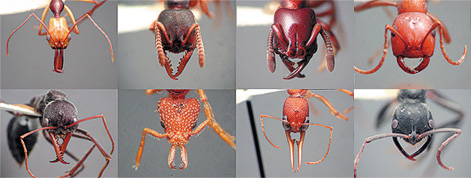
Morphological and Functional Diversity of Ant Mandibles


I just found this very nice site authored by Chris Schmidt on the morphological and functional diversity of ant mandibles. Awesome photos and very clear explanations. It is a treehouse on the Tree of Life. Check it out.

Update: Whoops! I forgot to include the link. Check it out here.
Tuesday, September 05, 2006

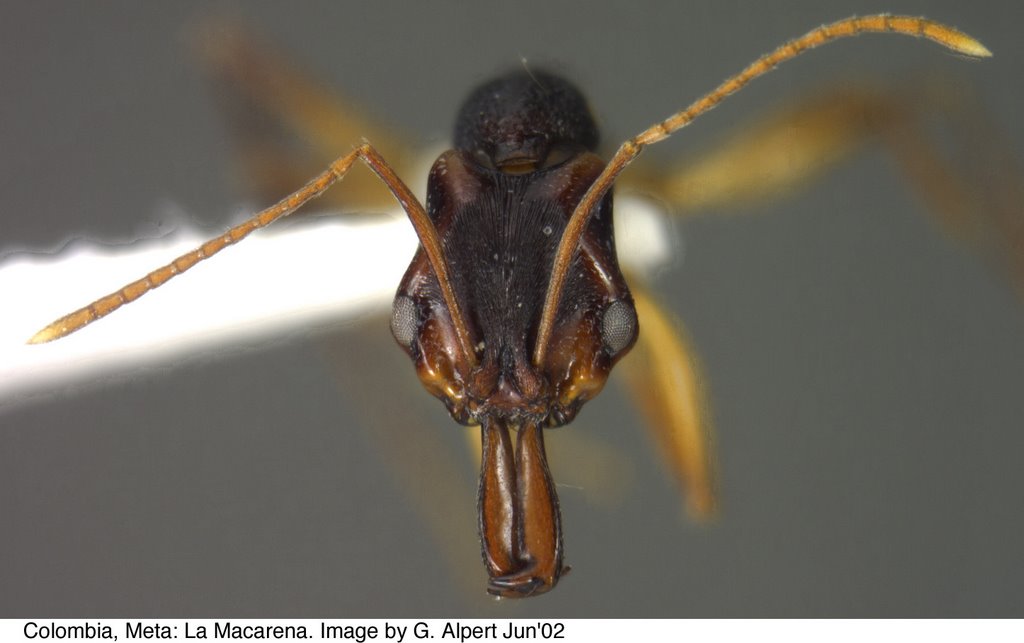
Anochetus bispinosus


Today I rechecked all of my Anochetus specimens. Why? Because I was browsing the Ants of Costa Rica web page and it said that Anochetus bispinosus was extremely rare and that in all the intensive collecting that had been done there they had only collected 3 workers from a single tree. And I have 4 specimens, so I started to doubt myself. Well, I have rechecked all of them and I am confident that all of my original identifications are correct, including the A. bispinosus specimens. It's actually a fairly easy key to deal with, and according to AntWeb, it has also been found in Brazil and Colombia, so it isn't crazy to find it in Ecuador. My four specimens (all workers) were collected by canopy fogging in 2 different trees fairly far removed from each other. I don't have pictures yet but they basically look exactly like the photos on the Ants of Costa Rica page.


More information:

From Bill and Emma Mackay's site -- a key to neotropical Anochetus can be found here.

From the Hymenoptera On-Line Database: Brown, W. L. 1978. Contributions toward a reclassification of the Formicidae. Part VI. Ponerinae, tribe Ponerini, subtribe Odontomachiti. Section B. Genus Anochetus and bibliography. Stud. Entomol. (N.S.) 20: 549-652. Browse or download entire file (5.3M)

From Jack Longino's Ants of Costa Rica site -- a key to Costa Rican species of Anochetus.

From the Hymenoptera Name Server -- a list of valid and invalid names including some original sources.

From AntWeb -- lots of Anochetus photos and specimen collection data.

From the MCZ Type Database -- a list of specimens at Harvard's Ant Room with lots o' photos. Just select "Hymenoptera" for Order and type in "Anochetus" under name.

From ponerine.org -- a really nifty list of Anochetus species which can be sorted taxonomically, alphabetically, by region, or by extant/extinct(ness). Awesome.